Installation
System Requirements
Required Hardware
- RAM: 1GB minimum with Moonshine models, 4GB+ recommended for Whisper/Parakeet models
- Disk Space: 100MB to 10GB depending on chosen AI model(s)
- Moonshine models: 35-80 MB (ideal for low-end hardware)
- Whisper/Parakeet models: 500 MB to 10 GB
- GPU (optional): Vulkan-compatible GPU for faster transcription (most modern NVIDIA, AMD, and Intel GPUs)
:::tip Low-End Hardware? If you have limited RAM or an older computer, try the Moonshine models. They use under 1GB of memory and still transcribe fast. Good pick for laptops and older machines. :::
Windows
- Windows 10 or Windows 11
macOS
- macOS 10.13 (High Sierra) or later
- Both Apple Silicon (M1 and newer) and Intel Macs are supported
Linux
- A modern 64-bit distribution (Ubuntu 22.04+, Fedora, and similar)
- Both Wayland (including Hyprland) and X11 are supported
- The
.deb/.rpmpull in everything needed automatically (including the tray library). Two extras depend on your setup:- GNOME users: install the AppIndicator extension so the tray icon shows. See no tray icon on GNOME.
- GPU acceleration: needs a Vulkan driver. See GPU Acceleration. (Optional; the app runs on the CPU otherwise.)
Download
Download the latest version of Knowii Voice AI from your Gumroad Library or from the Knowii Community website, depending on where you bought it from.
Choose the download for your platform:
- Windows:
.exeinstaller (setup.exe) - macOS:
.dmg. Pick the one for your Mac (aarch64for Apple Silicon,x64for Intel) - Linux:
.deb(Debian/Ubuntu),.rpm(Fedora/RHEL), or.AppImage(portable, runs on most distributions)
Installation Steps
Windows
- Download the installer (
.exe) - Run the installer
- Follow the installation wizard
- Launch Knowii Voice AI from the Start Menu or desktop shortcut
macOS
- Download the
.dmgfor your Mac (aarch64for Apple Silicon,x64for Intel) - Open the
.dmgand drag Knowii Voice AI into your Applications folder - Launch it from Applications or Spotlight
Knowii Voice AI is signed and notarized by Apple, so it opens without security warnings.
- Grant two permissions the first time you use it:
- Microphone — macOS asks when you start your first recording. Click Allow.
- Accessibility — needed to paste your dictations into other apps. If it is missing, the app tells you at startup and shows a banner on Settings > General: click Grant access, then turn on Knowii Voice AI in the list macOS opens. Until it is granted, each dictation is copied to the clipboard instead of being pasted, so nothing is lost. The banner disappears by itself once the switch is on — no restart needed.
Linux
Choose the package that matches your distribution:
-
Debian/Ubuntu (
.deb):sudo apt install ./Knowii.Voice.AI_<version>_amd64.deb -
Fedora/RHEL (
.rpm):sudo dnf install ./Knowii.Voice.AI-<version>-1.x86_64.rpm -
Any distribution (
.AppImage): no installation needed, just make it executable and run it:chmod +x Knowii.Voice.AI_<version>_amd64.AppImage./Knowii.Voice.AI_<version>_amd64.AppImage
After installing, launch Knowii Voice AI from your application menu (or run the AppImage directly).
Linux: which package should I choose?
Prefer the native package for your distribution (.deb or .rpm) whenever one exists. It configures everything automatically (keyboard access and reliable text output on GNOME/Wayland included), with no manual steps. Use the AppImage only when there's no native package for your distribution.
| Your situation | Best choice | Why |
|---|---|---|
| Debian, Ubuntu, Linux Mint, Pop!_OS | .deb | Sets up keyboard access and text output automatically. Nothing to configure |
| Fedora, RHEL, CentOS, openSUSE | .rpm | Same automatic setup as the .deb |
Arch, NixOS, or any distro without a .deb/.rpm | AppImage | Portable and runs anywhere, but needs a one-time manual setup on GNOME/Wayland (see below) |
| You're on GNOME (Wayland) and want zero setup | .deb / .rpm | These install and manage everything needed to type your transcriptions, with no prompts |
:::tip GNOME/Wayland users
If you can install the .deb or .rpm, do. They make text output work on GNOME with no permission prompts. The portable AppImage can't configure your system, so on GNOME it needs the one-time setup described under reliable text output.
:::
Linux: enable the global shortcut (keyboard access)
On Linux, Knowii Voice AI detects its global shortcut by reading your keyboard directly. This works on every desktop: GNOME, KDE, Hyprland, and X11. But it needs read access to your input devices.
-
.deb/.rpm: nothing to do. The package configures this automatically during installation, and it takes effect immediately. No logout or reboot required. Just install and run. -
AppImage: a portable file can't configure your system, so do this one-time step manually:
-
Add yourself to the
inputgroup:sudo usermod -aG input $USER -
Log out and back in (or reboot) for the change to take effect.
(Or simply install the
.deb/.rpminstead, which needs no setup.) -
Without keyboard access the app still runs, but pressing your shortcut won't do anything.
:::note Your privacy is protected This access simply lets the app watch for your shortcut key locally on your machine. It only reacts to the shortcut you configured, never records or stores your keystrokes, and never sends anything over the network. As always, everything stays on your computer. :::
Linux: reliable text output
To type transcriptions into your other apps, Knowii Voice AI uses the right method for your desktop automatically.
On GNOME (Wayland): built in
On GNOME, Knowii Voice AI types your transcriptions itself, directly and reliably:
- It types out your text matching your keyboard layout, so AZERTY, QWERTZ, Dvorak, and others all work correctly.
- It works everywhere, including terminals.
- There is no "Allow Remote Interaction" (Remote Desktop) prompt to click.
- Nothing extra to install: no
ydotool, no background daemon.
The only thing it needs is permission to use your system's virtual keyboard (/dev/uinput):
-
.deb/.rpm: automatic. Nothing to do. The package grants this access for you during installation. Just install and run. -
AppImage: a portable file can't configure your system, so run this one-time command to grant the access, then log out and back in once:
echo 'KERNEL=="uinput", SUBSYSTEM=="misc", OPTIONS+="static_node=uinput", TAG+="uaccess"' \| sudo tee /etc/udev/rules.d/72-knowii-voice-ai-uinput.rulessudo udevadm control --reload-rulessudo udevadm trigger --subsystem-match=misc --action=change
:::tip The easiest option on GNOME
Installing the .deb or .rpm grants everything automatically, with no commands to run. Choose it over the AppImage if your distribution supports it.
:::
On KDE, Hyprland/Sway, and X11: install your desktop's tool
On these desktops, Knowii Voice AI uses your desktop's standard input tool. Install the one for your desktop with your package manager (dnf, apt, pacman, zypper; the package name is the same everywhere):
| Desktop | Install | One-time setup |
|---|---|---|
| X11 (any desktop) | xdotool | None, works out of the box |
| KDE Plasma (Wayland) | kwtype | None |
| Hyprland / Sway (wlroots) | wtype | None |
The app auto-detects installed, compatible tools (it won't offer tools that can't work on your desktop). You can also choose a specific one under Settings → Advanced → Paste → Typing Tool. If none is installed, Knowii Voice AI shows a warning (and a banner in General and Advanced settings) with the exact command for your system.
First Launch
On first launch, Knowii Voice AI will:
- Show the first-time setup wizard
- Guide you through downloading your first AI transcription model (required)
- Configure basic settings
- Start running in your system tray
No account or registration is required!
GPU Acceleration (Optional)
Knowii Voice AI supports Vulkan out of the box for GPU-accelerated transcription. Vulkan works with most modern GPUs (NVIDIA, AMD, Intel) and is automatically detected and enabled if available.
CUDA support for NVIDIA GPUs is planned for a future release. See the Roadmap for more details.
:::note Linux: install a Vulkan driver for GPU acceleration
GPU acceleration on Linux needs a Vulkan driver (an ICD) for your GPU. The .deb/.rpm already pull in mesa-vulkan-drivers for you as a recommended dependency, so most installs are ready to go. You only need to install a driver by hand if you used the AppImage, skipped recommended dependencies, or run an NVIDIA GPU:
- Fedora / RHEL:
sudo dnf install mesa-vulkan-drivers(Intel/AMD). NVIDIA users get Vulkan from the NVIDIA driver package. - Debian / Ubuntu:
sudo apt install mesa-vulkan-drivers(Intel/AMD), or your GPU vendor's driver.
GPU acceleration speeds up Whisper, Moonshine and Parakeet V3 (GPU) — the original Parakeet and Omnilingual entries always run on the processor. Without a Vulkan driver the app still works; it simply transcribes on the CPU. :::
No graphics card? On Windows and Linux the app ships one build of its transcription engine per processor generation and picks the one that matches your processor when it starts, so processor-only transcription runs at the speed your machine allows. There is nothing to configure; the log mentions which build was picked (loaded CPU backend from … libggml-cpu-<name>) if you are curious.
Troubleshooting
Windows: Installer is blocked
Right-click the installer, select "Properties", and check "Unblock" before running.
Windows: "Windows protected your PC" warning
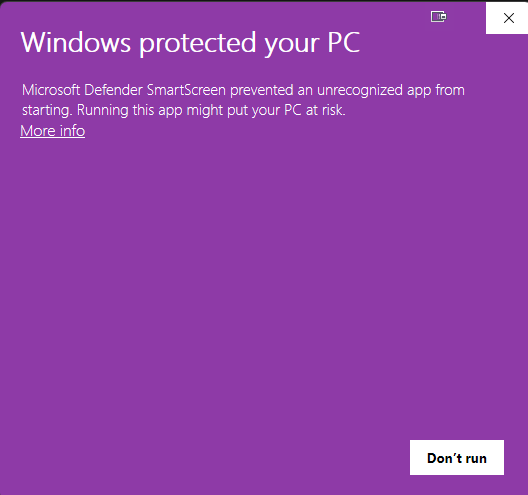
When launching the installer, Windows SmartScreen may display a warning: "Windows protected your PC". This is normal for new applications that don't yet have a large number of downloads.
To proceed with installation:
- Click on "More info"
- Click on "Run anyway"
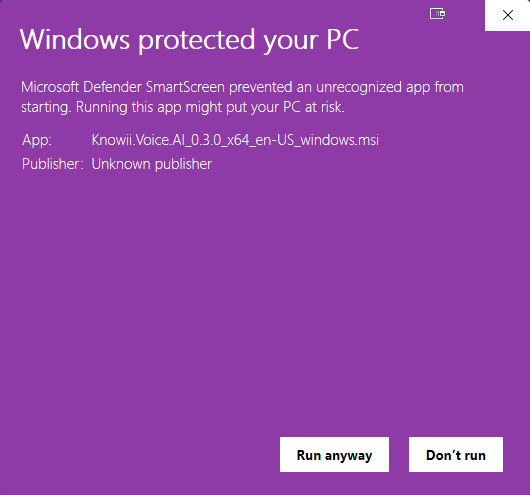
The installer will then launch normally. This warning appears because the application doesn't have an expensive code signing certificate yet, not because it's unsafe.
Windows: Installing to Program Files
If you want to install Knowii Voice AI in the Program Files folder, you must run the installer as administrator:
- Right-click the installer file
- Select "Run as administrator"
- Follow the installation wizard
Alternatively, you can install to your user directory (recommended), which doesn't require administrator privileges.
Windows: the app closes right after starting (APPCRASH in msvcp140.dll / vcruntime140.dll)
Older versions relied on the Microsoft Visual C++ runtime already being installed on your PC. A machine without it — or with a copy older than the one the app was built with — crashed before the first window appeared, with an "APPCRASH" pointing at msvcp140.dll or vcruntime140.dll.
Starting with the next release, the installer ships those runtime files next to knowii-voice-ai.exe, so this can no longer happen. If you still see it on an older version, install the Microsoft Visual C++ Redistributable (x64) and start the app again.
Windows: nothing is typed into a window that runs as administrator
Windows does not let a normal program send keystrokes or a paste into a window owned by a program running as administrator (an elevated terminal, editor, installer…). The keystrokes are silently dropped by the system — the app cannot work around it.
Knowii Voice AI detects this: when the window you are dictating into is elevated, the text is put on the clipboard instead and a notification tells you so. Paste it there yourself, or run Knowii Voice AI as administrator too (right-click its shortcut > Run as administrator) if you often dictate into elevated windows.
macOS: dictations are copied to the clipboard instead of pasted
macOS only lets apps with Accessibility access type into other apps. When Knowii Voice AI does not have it, every dictation is put on the clipboard and a notification tells you why. Open Settings > General, click Grant access on the banner and turn on Knowii Voice AI in the list. The banner and the clipboard fallback go away as soon as the switch is on.
If the app is already in the list but is still blocked — typically right after an update, because macOS ties the permission to the exact app version — turn its switch off and on again in System Settings > Privacy & Security > Accessibility (or remove the entry with the − button and click Grant access again). The banner's Open privacy settings button takes you straight to that page.
macOS: "Knowii Voice AI can't be opened"
Because the app is notarized by Apple, this normally won't happen. If you do see a Gatekeeper prompt (for example after downloading through certain browsers), right-click (or Control-click) the app in Applications and choose Open, then confirm. You only need to do this once.
Linux: AppImage won't run
- Make sure the file is executable:
chmod +x Knowii.Voice.AI_<version>_amd64.AppImage - If you get a FUSE error, install FUSE 2:
sudo apt install libfuse2(Debian/Ubuntu) or the equivalent for your distribution
Linux: missing dependencies for the .deb/.rpm
Installing with your package manager (sudo dnf install ./*.rpm, sudo apt install ./*.deb) pulls in everything automatically. The app relies on:
- WebKitGTK (
libwebkit2gtk-4.1) and GTK 3: present on any desktop. libappindicator-gtk3(for the system-tray icon): not preinstalled on stock Fedora Workstation;dnf/aptinstall it for you automatically.- Vulkan loader (
libvulkan, fromvulkan-loaderon Fedora /libvulkan1on Debian/Ubuntu): the app links against it and won't start without it, so the.deb/.rpmdeclare it as a required dependency and always pull it in. - Mesa Vulkan drivers (
mesa-vulkan-drivers): a recommended dependency, installed by default. Needed only for GPU-accelerated transcription with Whisper, Moonshine and Parakeet V3 (GPU) models (see GPU Acceleration); the original Parakeet and Omnilingual entries run on the processor and don't need it. - ALSA (
libasound2/alsa-lib), Opus (libopus0/opus), OpenSSL 3 (libssl3/openssl-libs), libxkbcommon and D-Bus client libraries: the app links against all of these directly, so the packages declare them and your package manager pulls them in. On a desktop they are already there.
If the package manager reports a missing dependency, install it and retry. If you install the .rpm/.deb offline (e.g. sudo rpm -i without a network), the required dependencies aren't resolved for you. Install the Vulkan loader (vulkan-loader on Fedora / libvulkan1 on Debian/Ubuntu) and libappindicator-gtk3 (Fedora) / libayatana-appindicator3-1 (Debian/Ubuntu) first, or the app may fail to start.
Linux: no tray icon on GNOME
Knowii Voice AI lives in your system tray (for Settings, Quit, and the Start hidden option). Vanilla GNOME does not show tray icons without an extension:
- Install the AppIndicator and KStatusNotifierItem Support GNOME extension (from extensions.gnome.org, or
sudo dnf install gnome-shell-extension-appindicatoron Fedora, then enable it in the Extensions app). - Log out and back in (or restart GNOME Shell). The tray icon appears on its own, with no need to restart Knowii Voice AI.
Already installed it and the icon still doesn't appear? GNOME can disable all extensions at once, and a GNOME upgrade can switch off ones it considers incompatible. See System tray icon missing on GNOME in the FAQ for the checks to run.
You can't lose the window on GNOME. When there's no tray icon, Knowii Voice AI automatically minimizes on close instead of hiding, ignores Start hidden, and shows a Quit button in the bottom-right corner, so the window is always reachable from the Activities overview or Alt+Tab, and you can always exit. The app also keeps watching for the tray, so once you enable the extension the icon appears on its own without restarting. KDE, Hyprland, and X11 desktops generally show the tray icon without extra setup.
Linux: my shortcut does nothing
The app needs read access to your keyboard to detect its global shortcut. If pressing the shortcut does nothing:
.deb/.rpm: this is set up automatically. Try fully quitting and reopening the app once after installing.- AppImage: complete the one-time keyboard access step, or install the
.deb/.rpminstead.
Application doesn't start
- Check system requirements
- Verify the application has permission to run
- Check system logs for error messages
On Linux, a blank window or a crash right after launch is usually a graphics-driver issue with a known workaround — see the Linux Troubleshooting page.
Updating
To update Knowii Voice AI to a newer version, see the Updating Guide for instructions on both automatic and manual updates.
Next Steps
Once installed, proceed to the Getting Started Tutorial to learn how to use Knowii Voice AI.